Hoy! Today, what a day. Tons of unexpected problems, and plenty of amazing people to help me out with them. Vaguely, the agenda of my trip to the Windy City: acquire passport photos for my visa; finish the visa application, perfect and copy; get some sleep; get to N. Michigan avenue and turn everything in at ten thirty en la manjana; get on a bus back home at noon or five. No problem right?
I arrived in Chicago last night by megabus - the purpose of the trip, a visit to the Spanish Consulate to apply for my student visa - after the ride, I spent a little too long wandering around in the cold looking for an open Walgreens for my liking, but I lived. Earlier I'd tried at my local Walgreens but their photo-making-machine was broken and I was forced to delay my passport photos accordingly, I figured, hell, it's downtown Chicago, there's a Wallgreens on every corner, this shouldn't be a problem. Much to my surprise, at seven forty en la noche, when I arrived most were closed and the closest open one was closing at eight. So I walked, in the wrong direction for a bit, then got in touch with one in Greek Town, and turned around accordingly. Forty minutes of walking and bam, photos in my hands in less than five minutes, things are looking up (or so I thought!).
After wandering past some pretty fancy hotels, I found a Holiday Inn and warmed up with a nicely made Chicago pizza. I cozied up in my room while the Pats whooped the Jets, texting back and forth with friends about football and politics. After, I finished my Visa application. I got some pretty dark complimentary copies of my important documents from the Holiday Inn, and then headed off to dreamland after an extra-long and exceptionally warm shower (this is by my standards, so it was probably still not as hot or lengthy as the one you're imagining - but it's the archetype, the experience that counts - not the exact details).
I woke up at 1:30, 3:47, 4:45, 6:34 and 7:35 (two minutes before my second alarm - I apparently slept through the first at 7:00). Each wake-up was preceded by a dream where I was irreparably late for my appointment at the consulate. So, I just got up, packed up, and then called my Mom for some advice in booking my flight. At this point in the morning, my biggest concern was whether or not I had to have the flight booked to apply for the visa. After the call, I checked my email on a whim, something had gone wrong, the first of what would be many troubles raised its ugly head. My loan didn't come through as planned and my tuition check bounced. A few phone-calls to the bank and some extra legwork (thanks again to my Ma and Jessica at my bank) and it was worked out, but I wouldn't find out until after the solution to problem three presented itself.
I had planned to take a train and walk to the consulate, but there was a cab outside the hotel as I was leaving, thinking perhaps this is providential, I took it. The cab driver tried to tell me that the consulate wasn't on Michigan, but on Ashland, that it had recently moved. I said, Sir, I respectfully request that you take me to Michigan - and if it's not there, then you can take me to Ashland. I let my smart phone do some finding, and sure enough, the Mexican consulate had recently moved from Michigan to Ashland, I explained that we were both right, and we had a nice chuckle about the mixup - Spain, Mexico, I mean, what's the difference (plenty more than just the distance from Michigan Ave to Ashland). Dodged a bullet there.
I arrived at the Spanish consulate about an hour early for my appointment, but was glad that I saw the sign inside that said I needed copies of ALL my documents (not just the Visa application itself). OMG, this is my fear, am I dodging another bullet? I hope so, I'm doing everything I can to be prepared. With a little help from the doorman (my first excellent person of the day), I was off to Kinko's, where I also acquired an envelope that was a little too small, but with a little help from my second excellent person of the day, I also got a free, slightly damaged envelope that was much larger (but not too oversized as to be useless). I stopped for a Mocha across the street from the consulate and tried to kill about half an hour.
About ten minutes earlier than my appointment I headed to the consulate and I was immediately seen, an outright contradiction to the consulate's website. The website makes it sound like a cold, hard, unfeeling bureaucracy, but I met excellent people three and four here. I also came into my second problem of the morning. See, my dog chewed up my passport when I moved at the end of this past summer, not much, just a little, but it was enough to qualify my passport for "mutilated" status and by law this brings "null-and-void" status (it says so right in the passport, though of course I'd never read that before it was pointed it out to me). My passport is rendered useless, except to get another passport and the people at the consulate are optimistic, I might even be able to get it today, they say. In my little country world, a passport takes weeks (even when expedited) - fortunately this is not so in the Windy City where the State department keeps an office. Excellent persons three and four let me know I should go and do this now, and I might even be able to get back by two (when they close).
So, I book it down to the State Department offices. My "Last Supper" belt buckle gets a few good laughs out of the security guards, "I would definitely wear this," one of them says, to which I reply, Does this mean I'm going away? We all had a nice laugh - I wish airports had this kind of sense of humor, but it might be better that they don't. I get upstairs, I wait in line for the better part of an hour - the whole time, hoping and praying that I get a kind hearted person on a good day, like a mantra, kind hearted person on a good day, kind hearted person on a good day... I have no appointment, I have no travel itinerary - this is a problem, this is problem three. After a little cajoling and a lot of puppy dog eyes, excellent person number five decides that my letter of acceptance IS enough to qualify for the intention to travel, and that I can get an emergency passport replacement. But I don't have passport photos, or the proper paperwork filled out and I still might not be able to get it today. Minor problems, we'll combine them as problem four. She gives me the proper paperwork, and sends me on my way, "Just come right up to my window when you're done."
I get two sets of slightly overpriced but very quick passport photos from a specialty business across the street, fly through the application, including frantic phone calls to both of my parents (I needed both of their locations of birth for the passport application), and I'm back at the State department. At this point, I have no idea if I'll be able to get my emergency passport today, tomorrow or next week in the mail. Excellent person number five shuffles me down to excellent person number six, who checks me out and tells me to come back and pick it up at three - after we make some jokes about Dogs/cuteness, the cost of chewing up passports, and that even though I didn't list it on my list of countries I intend to visit, that I should check out Morocco. I nervously agreed, hoping it wasn't a trick question, So I've heard, I said. After raising my right hand and signing a hurtfully large receipt, I was back on my way to the consulate - which of course, closes at two. It was one.
I opt for a cab, because it is cold and I'm sick of walking and sweating, there is no middle ground for me in the winter, I am too hot or I am cold, period. We get back to Michigan avenue and my card is declining. SRSLY? I'm calling the bank to find out what's going on while the cabbie is telling me that I'm declined again, and again, I try to explain, I tell him to keep the meter running - I know I've got money, maybe it's because I'm in Chicago (out of my town) and I've spent a few hundred dollars in the past twenty four hours. He "lets" me out after about five minutes, says forget about it. He's been speaking in Afrikaans or Arabic on a bluetooth since I got in, so I give him some nice blessings in Arabic, maybe it assuaged the burn I accidentally gave him. Turns out, when I finally get ahold of someone at the bank, it must have been his machine because there was no record of the transactions on their end. I decide I've got to get some cash, silly me - when I changed pants before I left the night before I didn't transfer my twenty two dollars in small bills.
Upon my return to the consulate, excellent persons three and four remain amenable, helpful and nice. They help me get my papers in order, and tell me to just bring the passport and slip it in the mail slot after I pick it up from the State department at three pm. I make a quick trip to the post office to get a return envelope for the passport that I don't even have, and voila, all that's left is to make it back to the state department and then back to the consulate. Turns out, that smaller envelope that I bought at Kinko's is going to be needed after all. And all the while, I've got Gogol Bordello running through my head. I stop at an ATM and pay a crazy stupid fee to pull out some cash for later emergencies. At this point, I'm beginning to suspect that this is in fact, "just one of those days."
I hate eating corporate in a place like Chicago, I mean, there's so many options. Still, I opt for a chain because I need some normalcy and I'm craving a mozzarella and basil sandwich. I killed about an hour for lunch with a wi-fi connection, doing some correspondence, writing a little, helping a friend with his sociology woes and finally booking my return bus for 4:55 pm. My smart phone tells me that It'll take me seventeen minutes to walk to the State department building. At 2:17 I start the walk, after a couple of short detours, it's twenty to three and I'm checking through security for the third time. I get up stairs, I show them that my phone is off (NO phones allowed in the State department) again, they send me to the room to wait.
In the room, I see many of the same people I saw earlier, just grumpier, more excitable and looking pretty worn out. I wait my turn at the window. My passport isn't finished, it is in process, just wait, thirty/forty minutes - max, he says. My heart sinks, I see my bus-ride slipping away and I start to feel stupid for not buying the refundable ticket. I cheer myself up, plenty of time I think to myself, I'll still be at the terminal by four thirty, NBD. Besides, without access to my phone I probably couldn't cancel the ticket anyway.
At four, the gentleman calls my name, my heart leaps for joy but when I get to the window he's not holding one of the blue passport envelopes that he's been handing out. They misspelled your name, he tells me, they're remaking it, just a few minutes longer. He then, disappears for an indeterminate amount of time and people start packing up behind the windows. There is no clock in the passport room, and you're not allowed to turn your phone on - too bad my phone is my watch. After what feels like an eternity, the huffy woman at the next window over calls my name. She seems pretty flummoxed by this turn of overtime events for her - I'm not even the last one in the room. I sign for the passport, I grab my mighty selection of winter wear that I've been alternating between wearing and carrying all day, and head for the door.
By the time I get my phone turned on it says four thirty four. I have twenty minutes to make it ten blocks, take a fifteen story elevator ride up and then back down, and then make it twenty five blocks to the bus-station. Cripes. Whatever hope I have is looking like fumes on a gas gage. Taxi time! 180 N. Michigan please. Elevator ride up. Brand-new passport into the undersized envelope from earlier, slipped into the mail slot so that it falls with my name and purpose face up - success. Call the elevator, it takes forever (or about ten seconds), it stops on the way down and floods with ladies, positive, jubilant ladies. We make a couple of quick jokes - I told them they might not want to get on the elevator with me, they told me they'd been stuck in THIS exact elevator just hours earlier. I'm thrilled when we touch down. I yog past them through the revolving door, apologizing, but they seemed to understand that I was hurried. It is 4:47, my bus is twenty five blocks away and leaves in eight minutes.
The first cab passes me by, the second cab passes me by - one full, one empty. The third cab brings me excellent person number seven and is the nicest cab I've been in all day, a Mercury Sable? who knew. I've got twenty dollars if you can get me to the greyhound station by 4:50, or just before 4:55. It's 4:48 and in as thick an Eastern-European accent as I've ever heard from an immigrant, he says, "Woy - maybe in eight minute. You got your ticket?" Nope, it's will-call, gotta pick it up. He "Woys" again. We get cut off by the same car three times, we get stuck behind two out of service busses, we hit the first four possible red lights, but then traffic broke and lights were green for a mile. We laughed the entire time, I told him my story - or at least an abridged version - and by no small miracle, in Chicago rush-hour traffic, he got me to the terminal at 4:54. He got the twenty.
I ran in. I mixed up the young woman at the counter's prompt for "Your credit card or confirmation number," and I started reading her my credit card... What number are you giving me? My credit card - No, I need your card OR your confirmation number. Woy. I give her the card, flash my ID, sign my ticket and I'm off again. Sir, Sir, she calls after me, I look back, It's that side. I was running to the wrong exit. I shift direction like a young Fred Taylor, and somehow maintain my momentum, only to have my exuberance noted by a guard - Woah there he says to me. 4:55 to Madison? I say. I can see the bus. Oh, he says. Ok, you almost missed it. He signs me off, walks me out (I swear I'm still yogging at this point, like I never stopped) and says to the driver, "We got a runner." And we're all laughing again. This is how my entire day has gone, I clue them both in. I can't believe how hard I had to work to make this happen, but it's even harder to believe that it all actually worked out.
Going into this, all I could think about was how perfect my paperwork needed to be and how scared I was about being turned away for not having everything correct. It turns out, perfect as it was, my paperwork was barely glanced at and most of what I've had to do involved legwork, sweat and the kindness of others. I never imagined that my day would end with a race to the bus depot, a brand-new passport with my information sitting in an envelope on the floor of the Spanish consulate waiting to be discovered en la manjana, and me blogging about my day in Chicago on the Wi-Fi connection of a Greyhound bus - but it is out of my hands now and it's over. Dio mediante, إن شاءالله , there's nothing more for me to do but book my flight... (And the adventure begins again? Woy, I hope not.)
Tuesday, December 7, 2010

Monday, November 15, 2010
Dear Scott Walker
You have made it apparent that you're very interested in cutting our high-speed rail project. By all accounts, you're looking into what it would take to give the money back, and you've said so much as well. Your emphasis, and I'm guessing impetus in cutting the rail project has to do with cutting government spending - in and of itself a noble goal, but nothing in life is free.
I fear that there is an idea that is gnawing at our American identity, this idea that things can just be had for free. It manifests in people who look to the government to provide for them without any, or with only limited personal involvement in the process. Welfare is a prime example of this, the government providing for the people (whether or not they deserve it is not up for debate, that's not my purpose), and in this last election, this idea was fostered by Republican across the country, including but not limited to this state. These candidates told us (the people) that they would bring the government budget(s) back into line with reality. Focusing on an ideology of independence and individual liberty, and tying big budgets to big government and high taxes. Americans are wary at the least of big, progressive government and the inherent loss of liberty that sort of forced taxation brings. But that is only one side of this coin.
The other side has to do with outsourcing, because you can't just cut from the budget without losing services - nature abhors a vacuum - what the government drops is either directly or indirectly outsourced to the private sector. Either civil programs that aid the underprivileged are cut never to return, which indubitably presents a raised cost to these hard-working, underprivileged, poor, tax-payers - or - other programs become privatized.
If you cut the Federal government funding from the train program, if you kill the train program, are you working in Wisconsin's best interests or are you working for the Federal government's best interests or are you looking out for the contractors who may pick up that cross and simply change the price-tag instead?
My point is this, you cannot outsource government programs to the private sector and claim any sort of aid to the taxpayer. Services that were once subsidized by tax dollars increase in price - possibly out of the range of those who would use them. Let's take a bus for example, or perhaps a high-speed train. If tax dollars, state or federal, are keeping a bus-fare low and that subsidy is taken away, the price to ride the bus increases (and people would demand more of the bus service accordingly - we already have non-public transportation in the form of personal automobiles and taxis) and the people who need it most are denied. In turn, the bus sees less business and less funding, then as though a miracle of the market, the bus folds and there is not public transportation. Obviously, because it is not profitable it is not beneficial - hopefully you can see through my sarcasm and recognize that as the bold-faced lie it is.
This is the myth of corporatism, of privatization, this is the cold, unfeeling hand of the market. It is dis-compassionate and it is based in an American mythology of the individual - even you sir could not have gotten to where you are (as an elected official) without the votes of people. You may be our face and you may be a very hard worker, but you are not the machine without us. Perhaps you could take the time out of your busy schedule to reevaluate your agenda.
You are the governor of our state, your duty is to the people of Wisconsin. Not to the upper classes, not to the privileged elites, not to the business interests who bankrolled you into office, not even to the Federal government - you are OUR governor and we are asking you to take notice of that. You were elected by less than a five percent margin, you have anything but a carte blanche to do what you will with this state and it's inhabitants. Your constituents include an incredible amount of working poor that transcends ethnic and racial lines.
And besides, wouldn't a high-speed train make your Milwaukee to Madison and back commute a little easier, I mean, you can afford it. Let the federal government worry about how much money they're going to give you or not, don't say no to help. This train isn't going to break the country, but your cuts into Wisconsin just might destroy the state - whether or not you can balance the budget because of them.
sincerely,
SAM
I fear that there is an idea that is gnawing at our American identity, this idea that things can just be had for free. It manifests in people who look to the government to provide for them without any, or with only limited personal involvement in the process. Welfare is a prime example of this, the government providing for the people (whether or not they deserve it is not up for debate, that's not my purpose), and in this last election, this idea was fostered by Republican across the country, including but not limited to this state. These candidates told us (the people) that they would bring the government budget(s) back into line with reality. Focusing on an ideology of independence and individual liberty, and tying big budgets to big government and high taxes. Americans are wary at the least of big, progressive government and the inherent loss of liberty that sort of forced taxation brings. But that is only one side of this coin.
The other side has to do with outsourcing, because you can't just cut from the budget without losing services - nature abhors a vacuum - what the government drops is either directly or indirectly outsourced to the private sector. Either civil programs that aid the underprivileged are cut never to return, which indubitably presents a raised cost to these hard-working, underprivileged, poor, tax-payers - or - other programs become privatized.
If you cut the Federal government funding from the train program, if you kill the train program, are you working in Wisconsin's best interests or are you working for the Federal government's best interests or are you looking out for the contractors who may pick up that cross and simply change the price-tag instead?
My point is this, you cannot outsource government programs to the private sector and claim any sort of aid to the taxpayer. Services that were once subsidized by tax dollars increase in price - possibly out of the range of those who would use them. Let's take a bus for example, or perhaps a high-speed train. If tax dollars, state or federal, are keeping a bus-fare low and that subsidy is taken away, the price to ride the bus increases (and people would demand more of the bus service accordingly - we already have non-public transportation in the form of personal automobiles and taxis) and the people who need it most are denied. In turn, the bus sees less business and less funding, then as though a miracle of the market, the bus folds and there is not public transportation. Obviously, because it is not profitable it is not beneficial - hopefully you can see through my sarcasm and recognize that as the bold-faced lie it is.
This is the myth of corporatism, of privatization, this is the cold, unfeeling hand of the market. It is dis-compassionate and it is based in an American mythology of the individual - even you sir could not have gotten to where you are (as an elected official) without the votes of people. You may be our face and you may be a very hard worker, but you are not the machine without us. Perhaps you could take the time out of your busy schedule to reevaluate your agenda.
You are the governor of our state, your duty is to the people of Wisconsin. Not to the upper classes, not to the privileged elites, not to the business interests who bankrolled you into office, not even to the Federal government - you are OUR governor and we are asking you to take notice of that. You were elected by less than a five percent margin, you have anything but a carte blanche to do what you will with this state and it's inhabitants. Your constituents include an incredible amount of working poor that transcends ethnic and racial lines.
And besides, wouldn't a high-speed train make your Milwaukee to Madison and back commute a little easier, I mean, you can afford it. Let the federal government worry about how much money they're going to give you or not, don't say no to help. This train isn't going to break the country, but your cuts into Wisconsin just might destroy the state - whether or not you can balance the budget because of them.
sincerely,
SAM
Saturday, November 13, 2010
Veteran's Day Redoux
This was written as a response to a lengthy Facebook comments feed on Veteran's day. A friend of mine (Jeff, a devoted and sincere pacifist and anarchist) said, "Soldiers are murderers, every single one signed up to kill. They sacrifice their own morality on the false altar of our corrupt government for lies of glory or desperation for money and education. Many of them don't have a choice in becoming soldiers, and for that I pity them. But I do not, and will not, respect anyone who CHOOSES to kill and die at the beck and call of the immoral fatcats." Needless to say, many of his friends took offense to this and responded in various ways - some personal, some with simply differing opinions. (the feed can be found here, or at least it was at one time.) I missed the entire conversation, but felt compelled to write the following - which I in turn much abbreviated and added as my two cents to the conversation.
I wrote,
Killers a killer. I know soldiers who are proud killers or at least like to say they are. Our military is being misused. Aggression and hegemony are not appropriate uses of military might.
My dad's birthday is Veterans day, he's the only one of his brothers who never served a day in the military. My Grandad was a sailor in the Navy during World War Two, he lied about his age to join up, he was sixteen. After the war he joined the Air Force, and served until he reached retirement. Neither of my Dad's older brothers were sent to Vietnam, my dad was too young to serve anyway. Rumor in my family is that Papa made a deal with the military, somehow. He had pretty high top-secret clearance, so my guess is he had some leverage. Wild conjecture but a good story nonetheless.
My step-brother is in the Army, he's been to Iraq four times. In his own words, he kills bad guys. I was socialized to love America, and in my own way I still do. As a child I read every history book about war I could get my hands on. I grew up wanting to be a soldier, but then when I was given the opportunity to break codes for Marine Intelligence, I decided I couldn't be a part of the machine that kills people. Jeff and I share the same month and day of birth in different years so I find that similarity to be an interesting correlation.
My Papa died of cancer when I was three. I barely remember it. Some of my earliest memories have to do with visiting him in the VA hospital with my parents, aunts, uncles and cousins. There's a good possibility that he died because of, or in relation to exposure to agent orange. I don't believe my Grandmother was ever able to be a part of the agent orange settlement, either because she chose not to participate, because my Papa's security level denied her access to his records, or perhaps one of uncountable other reasons.
Needless to say, my opinion of soldiers and soldiering is nuanced and mostly unimportant, and although I love the anarchist ideals that Jeff purports, they are not the way of the world and whether or not they should be is not what this discussion seemed to be about. I read all these comments and there are many good points that have been made - as well as an unfortunate amount of personal involvement. Something John Stewart said comes to mind, "We can have animus and not be enemies." You're friends, don't let THIS be what comes between you. Our differences are what make us strong, balanced. So the Jeff's are balanced out by the Killers, and vice versa.
That said, it's nice to bring up the the founding myth of the American Revolutionary war, and it's regular-fare to talk about Vietnam, but nobody talks about the US Civil War, which killed over six hundred thousand American soldiers. The north fought against the slaving south in as honorable a war for freedom as can be - and the south fought for their way of life, which they also described as freedom (just not for Blacks), but without Sherman's march to the sea, in which horrible atrocities were committed against the south, the victory of the Union, the country as we know it, history as we recall it would be very different. Horrible things are done to achieve and maintain.
After the revolution, we slaughtered the natives, then fought Mexicans, then each other, then the Spanish, then Mexicans again, then World War One, then World War Two, which ushered in the Nuclear age and the cold war. Then the hegemony and posturing against the communist menace - America as the world's savior. And! we won. But we didn't bring the troops home from Europe, we didn't bring them home from anywhere, we kept our military stationed worldwide; regardless of whether or not we want to admit it, we're acting as if the world is completely within our hegemony.
With the invention of the atomic bomb came the invention of National Security - nothing had ever been that big of a deal, and with good reason. What if the Nazi's had the bomb? (Some dude makes a mint writing about that.) The bomb put the President in charge of war, which is unconstitutional. One man isn't to be in charge of war, that's a king's duty or (a) God(s)'(s). It was extra-unconstitutional for our congress to give Bush II the right to declare war on Iraq, the pre-approved, pre-emptive strike (against a third world country that wouldn't admit they didn't have any WMD because they were worried they'd be invaded by Iran if they admitted it). Afghanistan, though much closer to a retributive strike for the attacks of 9/11 was still a violation of international law and the sanctity of Afghanistan as a nation - Afghanistan didn't declare war on the US, some people who happened to be hiding out there did. Now, we're still fighting in both places, eight and ten years after the fact. Struggles longer than either of the World Wars, longer than the US Civil War, and almost as long as the US involvement in Vietnam.
The grander point that I am trying to reach here is that regardless of how one feels about what happened on 9/11, our wars in the Middle East and Western Asia are not "just" wars - they are wars of hegemony. We decided that these other countries (or more accurately, what was going on in these countries) were (was) problematic for our interests, regardless of their national sovereignty. This is practically a dictionary definition of hegemony. This would be reverse of the situation regarding Switzerland and Nazi Germany - if the Nazi's had gone decided that the correct answer wasn't to bypass Switzerland to get to France, but instead to just simply invade Switzerland. Or if the rest of Europe had decided that Nazi Germany was to be stopped - which is the rhetoric that was used to whip up the pro-war frenzy in the wake of 9/11. The fundamental difference between the rhetoric and reality is the difference between a nation invading another nation and a nation invading a nation to get at a group of people hiding-out in that other nation. That'd be like Mexico invading the US to get at drug dealers hiding out here - or vice versa. But I think it's important to note the difference in feeling to our country being invaded vs. our country invading another country. One makes us the victim, the other the hero. By that same logic, that makes Afghanistan the victim, though we still like to imagine that we're the hero. The foil to a victim isn't a hero but a perpetrator of Evil.
Lastly, I think it's difficult to say who would do what, when x and/or y variable occurs. Reality makes, and history has a record of unlikely and awkward heroes, strange bedfellows and surprise killers for better and for worse. People complain about the media and a slanted message, they should turn that directly on the slanted lens of history. In a way I find it hard not to see this nation as a self important bully with a long and violent history of same, but we've stood against (what have been portrayed as) more-evil-states that could have otherwise shaped the world, for better or for worse, but we're writing the history books, because we're winning.
But the unfortunate side effect of our victories has left an unbalance - there's no ONE, clear enemy anymore, or at least not a NATION - and we're not willing to put down our dukes, even though we're drained like an aging punch-drunk champion fighting against shadows. It's just sad that though what lurks behind some shadows is genuinely unhappy and possibly willing to kill us, and behind the rest are innocent bystanders.
It takes a lot to kill but if you pay your taxes you're suporting it. So if you don't agree with it, either stop paying your taxes (in which case you go to jail and basically wind up a ward of the state who winds up contributing in other ways) or as some love to remind those who feel differently than they do about love of country and freedom, maybe it's best to just leave - but where does one go? Perhaps to a democratic-socialist state, like Switzerland, or anywhere in Scandinavia. No where's really perfect, because we're not, but if America wants to continue to see itself as the hero and savior of the planet, her people, liberty and freedom, we've got much harder work ahead of us that doesn't involve anything remotely akin to invading countries and waging war. We need to wage a war against our selves and see our own faults and flaws.
Killing is killing, a person who kills is a killer. Sometimes, killing can be done in the best interests of a large amount of people, but it is never in the best interests of the killed or their relations. If we don't change our methods and our ideologies, we are going to create a world that is hardly worth living in, let alone killing for, and far too many people are going to die. But then again, sooner or later, there's going to be too many of us for this lil'blue planet and we're going to have to figure something else out or we're all going to die.
I wrote,
Killers a killer. I know soldiers who are proud killers or at least like to say they are. Our military is being misused. Aggression and hegemony are not appropriate uses of military might.
My dad's birthday is Veterans day, he's the only one of his brothers who never served a day in the military. My Grandad was a sailor in the Navy during World War Two, he lied about his age to join up, he was sixteen. After the war he joined the Air Force, and served until he reached retirement. Neither of my Dad's older brothers were sent to Vietnam, my dad was too young to serve anyway. Rumor in my family is that Papa made a deal with the military, somehow. He had pretty high top-secret clearance, so my guess is he had some leverage. Wild conjecture but a good story nonetheless.
My step-brother is in the Army, he's been to Iraq four times. In his own words, he kills bad guys. I was socialized to love America, and in my own way I still do. As a child I read every history book about war I could get my hands on. I grew up wanting to be a soldier, but then when I was given the opportunity to break codes for Marine Intelligence, I decided I couldn't be a part of the machine that kills people. Jeff and I share the same month and day of birth in different years so I find that similarity to be an interesting correlation.
My Papa died of cancer when I was three. I barely remember it. Some of my earliest memories have to do with visiting him in the VA hospital with my parents, aunts, uncles and cousins. There's a good possibility that he died because of, or in relation to exposure to agent orange. I don't believe my Grandmother was ever able to be a part of the agent orange settlement, either because she chose not to participate, because my Papa's security level denied her access to his records, or perhaps one of uncountable other reasons.
Needless to say, my opinion of soldiers and soldiering is nuanced and mostly unimportant, and although I love the anarchist ideals that Jeff purports, they are not the way of the world and whether or not they should be is not what this discussion seemed to be about. I read all these comments and there are many good points that have been made - as well as an unfortunate amount of personal involvement. Something John Stewart said comes to mind, "We can have animus and not be enemies." You're friends, don't let THIS be what comes between you. Our differences are what make us strong, balanced. So the Jeff's are balanced out by the Killers, and vice versa.
That said, it's nice to bring up the the founding myth of the American Revolutionary war, and it's regular-fare to talk about Vietnam, but nobody talks about the US Civil War, which killed over six hundred thousand American soldiers. The north fought against the slaving south in as honorable a war for freedom as can be - and the south fought for their way of life, which they also described as freedom (just not for Blacks), but without Sherman's march to the sea, in which horrible atrocities were committed against the south, the victory of the Union, the country as we know it, history as we recall it would be very different. Horrible things are done to achieve and maintain.
After the revolution, we slaughtered the natives, then fought Mexicans, then each other, then the Spanish, then Mexicans again, then World War One, then World War Two, which ushered in the Nuclear age and the cold war. Then the hegemony and posturing against the communist menace - America as the world's savior. And! we won. But we didn't bring the troops home from Europe, we didn't bring them home from anywhere, we kept our military stationed worldwide; regardless of whether or not we want to admit it, we're acting as if the world is completely within our hegemony.
With the invention of the atomic bomb came the invention of National Security - nothing had ever been that big of a deal, and with good reason. What if the Nazi's had the bomb? (Some dude makes a mint writing about that.) The bomb put the President in charge of war, which is unconstitutional. One man isn't to be in charge of war, that's a king's duty or (a) God(s)'(s). It was extra-unconstitutional for our congress to give Bush II the right to declare war on Iraq, the pre-approved, pre-emptive strike (against a third world country that wouldn't admit they didn't have any WMD because they were worried they'd be invaded by Iran if they admitted it). Afghanistan, though much closer to a retributive strike for the attacks of 9/11 was still a violation of international law and the sanctity of Afghanistan as a nation - Afghanistan didn't declare war on the US, some people who happened to be hiding out there did. Now, we're still fighting in both places, eight and ten years after the fact. Struggles longer than either of the World Wars, longer than the US Civil War, and almost as long as the US involvement in Vietnam.
The grander point that I am trying to reach here is that regardless of how one feels about what happened on 9/11, our wars in the Middle East and Western Asia are not "just" wars - they are wars of hegemony. We decided that these other countries (or more accurately, what was going on in these countries) were (was) problematic for our interests, regardless of their national sovereignty. This is practically a dictionary definition of hegemony. This would be reverse of the situation regarding Switzerland and Nazi Germany - if the Nazi's had gone decided that the correct answer wasn't to bypass Switzerland to get to France, but instead to just simply invade Switzerland. Or if the rest of Europe had decided that Nazi Germany was to be stopped - which is the rhetoric that was used to whip up the pro-war frenzy in the wake of 9/11. The fundamental difference between the rhetoric and reality is the difference between a nation invading another nation and a nation invading a nation to get at a group of people hiding-out in that other nation. That'd be like Mexico invading the US to get at drug dealers hiding out here - or vice versa. But I think it's important to note the difference in feeling to our country being invaded vs. our country invading another country. One makes us the victim, the other the hero. By that same logic, that makes Afghanistan the victim, though we still like to imagine that we're the hero. The foil to a victim isn't a hero but a perpetrator of Evil.
Lastly, I think it's difficult to say who would do what, when x and/or y variable occurs. Reality makes, and history has a record of unlikely and awkward heroes, strange bedfellows and surprise killers for better and for worse. People complain about the media and a slanted message, they should turn that directly on the slanted lens of history. In a way I find it hard not to see this nation as a self important bully with a long and violent history of same, but we've stood against (what have been portrayed as) more-evil-states that could have otherwise shaped the world, for better or for worse, but we're writing the history books, because we're winning.
But the unfortunate side effect of our victories has left an unbalance - there's no ONE, clear enemy anymore, or at least not a NATION - and we're not willing to put down our dukes, even though we're drained like an aging punch-drunk champion fighting against shadows. It's just sad that though what lurks behind some shadows is genuinely unhappy and possibly willing to kill us, and behind the rest are innocent bystanders.
It takes a lot to kill but if you pay your taxes you're suporting it. So if you don't agree with it, either stop paying your taxes (in which case you go to jail and basically wind up a ward of the state who winds up contributing in other ways) or as some love to remind those who feel differently than they do about love of country and freedom, maybe it's best to just leave - but where does one go? Perhaps to a democratic-socialist state, like Switzerland, or anywhere in Scandinavia. No where's really perfect, because we're not, but if America wants to continue to see itself as the hero and savior of the planet, her people, liberty and freedom, we've got much harder work ahead of us that doesn't involve anything remotely akin to invading countries and waging war. We need to wage a war against our selves and see our own faults and flaws.
Killing is killing, a person who kills is a killer. Sometimes, killing can be done in the best interests of a large amount of people, but it is never in the best interests of the killed or their relations. If we don't change our methods and our ideologies, we are going to create a world that is hardly worth living in, let alone killing for, and far too many people are going to die. But then again, sooner or later, there's going to be too many of us for this lil'blue planet and we're going to have to figure something else out or we're all going to die.
Monday, November 8, 2010
sometimes, original works are not the best idea
I wish I had something profound to say to you today, something that would turn everything wrong on its head and make everything right again - the election didn't do that and neither can I. If you think it did, or I can, you are sadly mistaken and horribly wrong. Please connect the dots:
1.) Read this or, if you don't like to read and have lots of time, watch this, (good stuff starts @ the 2:50 mark) Bill Moyers speech @ Boston University on October 29th, just days before the election. It's long but informative, horribly informative. His argument appeals not to emotion but to logic and morality, and it finds an unfortunate amount of traction in reality.
2.) "Speak, money" by Roger D. Hodge, the article is referenced in the Moyers speech. It's not as long, but still long.
3.) This is Mitch McConnell, say what you will about Obama's double speak - this is about as duplicitous as it get - read what he's quoted as saying in the Moyers speech and then watch this.
(optional) Extra Credit: Read "So Much Damn Money" by Robert G. Kaiser, or listen to this reading of an excerpt from it on NPR.
AMERICA, WAKE UP! It's true, the politicians aren't working for us anymore, they're working for plutocracists or plutonomists. They are working for the people who are really running the show and calling the shots from behind the camera, like the difference between actors and the director. They will say anything to make you feel good about yourself and the direction of the country, but ultimately, neither the Republicans nor the Democrats are saying the truth, are doing the "right" thing by the people, and are guiding us towards a better, freer, more American future. We're being sold a giant satchel of lies. The people in office are just paying lip-service to the constitution and to our best interests, and way too many people are listening to them.
1.) Read this or, if you don't like to read and have lots of time, watch this, (good stuff starts @ the 2:50 mark) Bill Moyers speech @ Boston University on October 29th, just days before the election. It's long but informative, horribly informative. His argument appeals not to emotion but to logic and morality, and it finds an unfortunate amount of traction in reality.
2.) "Speak, money" by Roger D. Hodge, the article is referenced in the Moyers speech. It's not as long, but still long.
3.) This is Mitch McConnell, say what you will about Obama's double speak - this is about as duplicitous as it get - read what he's quoted as saying in the Moyers speech and then watch this.
(optional) Extra Credit: Read "So Much Damn Money" by Robert G. Kaiser, or listen to this reading of an excerpt from it on NPR.
AMERICA, WAKE UP! It's true, the politicians aren't working for us anymore, they're working for plutocracists or plutonomists. They are working for the people who are really running the show and calling the shots from behind the camera, like the difference between actors and the director. They will say anything to make you feel good about yourself and the direction of the country, but ultimately, neither the Republicans nor the Democrats are saying the truth, are doing the "right" thing by the people, and are guiding us towards a better, freer, more American future. We're being sold a giant satchel of lies. The people in office are just paying lip-service to the constitution and to our best interests, and way too many people are listening to them.
Friday, October 29, 2010
in the ghetto...
I was walking around on the verge of tears this morning (for various reasons, mostly war and inspired, religious ignorance) and I saw a young woman walking around like nothing was wrong - and then another and another. I thought about how parents protect their children from the dangers of the world, or at least they do what they can, but at some point it's not enough. Isn't it time we moved out of the ghetto?
Wednesday, October 20, 2010
An Indirect Reply to Peter Berkowitz
I'm no Peter Berkowitz. My bio doesn't include words like "Stanford" or "Senior Fellow" but I kind of like it that way. I read this article by Peter Berkowitz on the Wall Street Journal, it was OK. I mean, I don't take it whole, and by that I mean I don't agree entirely. In fact, I agree more so on a conceptual level than with the articulation of his points. But honestly, I'm just a student, I'm asking you NOT to take my word for it, I'm asking you to look at it yourself because that is what being a student is really about.
When I was twenty five I read "Zen and the Art of Motorcycle Maintenance," a somewhat plodding but ultimately enjoyable and enlightening mental exploration of a shattered psyche. What I took from this book was the outlook observed by the protagonist, Phaedrus (which means wolf in latin, or something) that he does not go to school for grades but for knowledge. The idea is that you go to school to learn, if you learn, grades will follow. If you go to school for grades, or even just to pass, you might not really learn anything at all (except, possibly, how to pass a class - which may or may not include learning).
I just completed this one hundred level Sociology course, an intro course, and about three quarters of the way through we wound up talking about education, and what was important to education. One of my classmates had just had a realization, that it's about learning not about grades, it's about being familiar with the subject and the material not just about the test scores and study guide syndrome. It's really just some simple logic. Let P stand for, "I learn the material" and Q, "I pass the test." If P then Q. If you have P, you will have Q. If you have Q, you may or may not have P.
Being a student who is currently involved in the system, I might be blind to what Berkowitz is complaining about - I mean - pointing out. But, being a student who is in the system I am witnessing some of what he's mentioning first hand. Not everybody is making the realization of my classmate. Some people are not involved in the material. Some people do not dive in head first and dig themselves a foxhole in the front-row (even if they did, everybody can't fit in the front row, nor does everyone need to, it's more like a metaphor than a truth anyway), submerged in the subject, deep in unfamiliar territory. Some students are busy raising kids, or working to maintain, not just the cost of college but, lifestyles, homes, habits and/or whole families. There are those students who are on the struggle, but there are plenty of students who just don't take it seriously and plenty of others who might not actually be intuitive enough to grasp the concepts early or have been prepped by authoritarian backgrounds and parenting to accept what's presented to them without too much questioning. BAsically Berkowitz, the problem isn't necessarily the system or the focus of higher education but the students, who quickly become graduates. You say it's the system of higher education and the waste of resources, mismanaged and misguided teachers and institutions that lie at fault here, but it's more than that and it runs much deeper.
You, sir, mention some pretty big names that I would appear to be insulting but there is a caveat to my theory, and by implication, to yours as well. The opinions given by the editorialists you mention aren't wrong, though they're not any more right than you or, dare I say, myself, they are opinions. Hooray for opinions. Pretty American, nay, pretty human to have one of those, we're just fortunate to live in a place where we're not supposed to be punished for our thoughts, at least not beyond the scathing retorts, the opinions of our fellow human beings. In a way, the Tea Party is just that - even though I preferred when they called themselves Tea Baggers. Lulz. But my point is this, the Tea Party does represent a marginal slice of a marginalized group (including a slightly highershare of what you called, "clowns, kooks and creeps"); and, when TV personalities promote the event it's not a grass-roots thing anymore (ask any underground club promoter about that kind of nonsense); the Tea Party is getting billions of dollars of support from multimillionaire libertarians (who built on inherited wealth, never ceases to crack me up - way to build it, but you still didn't do it on your own).
When the movement is talking about the need to replace out of touch, incompetent politicians with people who will fight for freedom, the "favored candidates" shouldn't be the ones making "embarrassing statements" or the ones who "embraced reckless policies." That is counter-productive at the very least and paradoxical at worst - ultimately, I agree with you in that this does not differentiate them from the political pack or the political mainstream, but what I believe is important to note is that THOSE are not the PEOPLE who should be chosen. If we're going to say no more slick, self-serving, career politicians do we have to choose idiots, incompetents and regressive ones over them? (And! if the problem lies less with our representatives but with the system of money and lobbyists, wouldn't idiots, incompetents and regressives be MORE susceptible to the machinations of a high powered, unfeeling political machine that's not about truth or constituents' desires as much as the language of cold hard cash?)
But whatever, I'm a high-school drop out from a divorced family - if I see any success in life I will be an outlier on the mathematical models and systematic surveys that proponents of higher education are so fond of. Similar to the mathematical models used to predict politics and what's being taught at our revered institutions, where legions of empiricists are turned out yearly, equipped with that most unfriendly of swords, reason. At least, to a certain degree that they are not just deaf-mute followers without original thoughts and opinions, or total slackers who just managed to get through it all and whose father is connected to some industry so... Favoritism, flattery and nepotism are alive and well in human nature, America is not immune - somehow even in situations of democracy (if not in popular votes, then in the electoral college and I'm looking at you: the supreme court). But honestly, though I don't completely disagree with your disdain for the problems and biases of higher education in these United States, I think you're missing a bigger problem that starts much earlier.
The system is flawed before "higher-education" even comes into the picture. You mention that "leading history departments have emphasized social history and issues of race, class and gender at the expense of constitutional history, diplomatic history and military history." I can't say one way or another on this, but I have a two pronged question to throw your way. (1) Public education needs to be reformed for the twenty-first century, k-12, public education is a government program - moving away from education is not the answer, reform is. Reform takes money, reform takes effort, reform takes time. How do we find a way to educate Americans that benefits American ideals - instead of benefiting a fading blue-collar factory based time-schedule - without public funding and public interest? (2) What if history could be taught in a way that emphasized both what it means to be an American AND the importance of social history? What if we could show students how our social history is a constant progression, something that successive waves of generations shape and reshape through their interactions, while still stressing the importance of liberty? From slave owning Washington and Jefferson, to Martin Luther King Jr and Malcolm X, America is what we make it. From the constitution to the white house.
My problem with your suggestion for shifting historical focus is twofold as well. First, I'm not against teaching military history, diplomatic history or even "constitutional history" as you suggest - but I wonder where you draw the ethnocentric lines, I mean, how biased is this curriculum going to be? Just American, or is it more inclusive? There's been plenty of wars, how many people do you think really need to study that? How deep are you asking EVERYONE to go into military history, or even diplomatic history (aren't they rather intertwined?) Second, at some point it has to be recognized that we live in an unequal world and we either embrace TOTAL FREEDOM and let those inequalities be (which can easily turn into sacrificing one group for the benefit of another - rich/poor; black/white; blue collar union/immigrant and outsourced labor;) or, we look to level aspects of the playing field (like the wage divide between men and women, like the reality of institutional discrimination, and/or the disproportionate representation of aging, white-males in the upper echelons of the private and public sectors).
My problems with the tea party lie in the marginal aspects, and their lack of acknowledgment of the power of the private sector, embracing concepts like conspiratorial "shadow masters" instead of just taking a look at the system prepared to accept that there are no quick fixes, and shift the focus to the long term and to change, not regressive reforms. My problems with Tea Party ideology has nothing to do with their ideas about limiting the power of government and everything to do with the facts on the ground, they are not, I repeat NOT, putting up a higher quality of person in place of those they decry so vehemently. You called attention to that. (Though, kudos to their library mall clean-up efforts, post "restoring honor" rally. My hat is off to those "grizzly mommas" who made it happen with their garbage-bag brigades. We could all be a little cleaner.) It's the demagoguery of our politics and our media that's got this all wrong, nobody is really preaching in the street these days, and nobody is listening when they do - our minds are made up - we just preach to the choir and we talk really badly about the "other" sides - rattle the sabers and get everybody fired up.
Ultimately, even in America with all these freedoms we have to learn to get along with each other or all these fancy systems are just for show and our "freedom" is no better than bull$hit. Our forefathers expected us to be involved and educated, they expected us to be like them, to use our freedoms to thrive not merely economically, but spiritually, emotionally, mentally and physically, to be free but more importantly to be wise - because freedom is the ultimate gateway to experience. We have to immerse ourselves in this material, learn it, be it, believe it or we'll never become what we are tasked with being. It is true, we do need to make some tough reforms in our government and social institutions, but a reactionary movement is not necessarily the best direction for the country, especially when it's not putting anything better into office and pushing issues that divide while doing nothing to counteract problems in our decaying representative government, nothing for foreign policy, nothing for the masses and indirectly handing the keys back to big industry (that's shipping our jobs out of the country to increase their profit margins). We can't do much about who's in charge in the private sector, but we can at least vote for politicians who will slow their dominance in the public - regardless of what a marginalized margin of a marginalized group says, no matter how loud they shout.
Oh yeah, and I can't tell you what to do, but I think it's a good move to vote for Russ Feingold on November 2, 2010 (if you live in Wisconsin anyway).
When I was twenty five I read "Zen and the Art of Motorcycle Maintenance," a somewhat plodding but ultimately enjoyable and enlightening mental exploration of a shattered psyche. What I took from this book was the outlook observed by the protagonist, Phaedrus (which means wolf in latin, or something) that he does not go to school for grades but for knowledge. The idea is that you go to school to learn, if you learn, grades will follow. If you go to school for grades, or even just to pass, you might not really learn anything at all (except, possibly, how to pass a class - which may or may not include learning).
I just completed this one hundred level Sociology course, an intro course, and about three quarters of the way through we wound up talking about education, and what was important to education. One of my classmates had just had a realization, that it's about learning not about grades, it's about being familiar with the subject and the material not just about the test scores and study guide syndrome. It's really just some simple logic. Let P stand for, "I learn the material" and Q, "I pass the test." If P then Q. If you have P, you will have Q. If you have Q, you may or may not have P.
Being a student who is currently involved in the system, I might be blind to what Berkowitz is complaining about - I mean - pointing out. But, being a student who is in the system I am witnessing some of what he's mentioning first hand. Not everybody is making the realization of my classmate. Some people are not involved in the material. Some people do not dive in head first and dig themselves a foxhole in the front-row (even if they did, everybody can't fit in the front row, nor does everyone need to, it's more like a metaphor than a truth anyway), submerged in the subject, deep in unfamiliar territory. Some students are busy raising kids, or working to maintain, not just the cost of college but, lifestyles, homes, habits and/or whole families. There are those students who are on the struggle, but there are plenty of students who just don't take it seriously and plenty of others who might not actually be intuitive enough to grasp the concepts early or have been prepped by authoritarian backgrounds and parenting to accept what's presented to them without too much questioning. BAsically Berkowitz, the problem isn't necessarily the system or the focus of higher education but the students, who quickly become graduates. You say it's the system of higher education and the waste of resources, mismanaged and misguided teachers and institutions that lie at fault here, but it's more than that and it runs much deeper.
You, sir, mention some pretty big names that I would appear to be insulting but there is a caveat to my theory, and by implication, to yours as well. The opinions given by the editorialists you mention aren't wrong, though they're not any more right than you or, dare I say, myself, they are opinions. Hooray for opinions. Pretty American, nay, pretty human to have one of those, we're just fortunate to live in a place where we're not supposed to be punished for our thoughts, at least not beyond the scathing retorts, the opinions of our fellow human beings. In a way, the Tea Party is just that - even though I preferred when they called themselves Tea Baggers. Lulz. But my point is this, the Tea Party does represent a marginal slice of a marginalized group (including a slightly highershare of what you called, "clowns, kooks and creeps"); and, when TV personalities promote the event it's not a grass-roots thing anymore (ask any underground club promoter about that kind of nonsense); the Tea Party is getting billions of dollars of support from multimillionaire libertarians (who built on inherited wealth, never ceases to crack me up - way to build it, but you still didn't do it on your own).
When the movement is talking about the need to replace out of touch, incompetent politicians with people who will fight for freedom, the "favored candidates" shouldn't be the ones making "embarrassing statements" or the ones who "embraced reckless policies." That is counter-productive at the very least and paradoxical at worst - ultimately, I agree with you in that this does not differentiate them from the political pack or the political mainstream, but what I believe is important to note is that THOSE are not the PEOPLE who should be chosen. If we're going to say no more slick, self-serving, career politicians do we have to choose idiots, incompetents and regressive ones over them? (And! if the problem lies less with our representatives but with the system of money and lobbyists, wouldn't idiots, incompetents and regressives be MORE susceptible to the machinations of a high powered, unfeeling political machine that's not about truth or constituents' desires as much as the language of cold hard cash?)
But whatever, I'm a high-school drop out from a divorced family - if I see any success in life I will be an outlier on the mathematical models and systematic surveys that proponents of higher education are so fond of. Similar to the mathematical models used to predict politics and what's being taught at our revered institutions, where legions of empiricists are turned out yearly, equipped with that most unfriendly of swords, reason. At least, to a certain degree that they are not just deaf-mute followers without original thoughts and opinions, or total slackers who just managed to get through it all and whose father is connected to some industry so... Favoritism, flattery and nepotism are alive and well in human nature, America is not immune - somehow even in situations of democracy (if not in popular votes, then in the electoral college and I'm looking at you: the supreme court). But honestly, though I don't completely disagree with your disdain for the problems and biases of higher education in these United States, I think you're missing a bigger problem that starts much earlier.
The system is flawed before "higher-education" even comes into the picture. You mention that "leading history departments have emphasized social history and issues of race, class and gender at the expense of constitutional history, diplomatic history and military history." I can't say one way or another on this, but I have a two pronged question to throw your way. (1) Public education needs to be reformed for the twenty-first century, k-12, public education is a government program - moving away from education is not the answer, reform is. Reform takes money, reform takes effort, reform takes time. How do we find a way to educate Americans that benefits American ideals - instead of benefiting a fading blue-collar factory based time-schedule - without public funding and public interest? (2) What if history could be taught in a way that emphasized both what it means to be an American AND the importance of social history? What if we could show students how our social history is a constant progression, something that successive waves of generations shape and reshape through their interactions, while still stressing the importance of liberty? From slave owning Washington and Jefferson, to Martin Luther King Jr and Malcolm X, America is what we make it. From the constitution to the white house.
My problem with your suggestion for shifting historical focus is twofold as well. First, I'm not against teaching military history, diplomatic history or even "constitutional history" as you suggest - but I wonder where you draw the ethnocentric lines, I mean, how biased is this curriculum going to be? Just American, or is it more inclusive? There's been plenty of wars, how many people do you think really need to study that? How deep are you asking EVERYONE to go into military history, or even diplomatic history (aren't they rather intertwined?) Second, at some point it has to be recognized that we live in an unequal world and we either embrace TOTAL FREEDOM and let those inequalities be (which can easily turn into sacrificing one group for the benefit of another - rich/poor; black/white; blue collar union/immigrant and outsourced labor;) or, we look to level aspects of the playing field (like the wage divide between men and women, like the reality of institutional discrimination, and/or the disproportionate representation of aging, white-males in the upper echelons of the private and public sectors).
My problems with the tea party lie in the marginal aspects, and their lack of acknowledgment of the power of the private sector, embracing concepts like conspiratorial "shadow masters" instead of just taking a look at the system prepared to accept that there are no quick fixes, and shift the focus to the long term and to change, not regressive reforms. My problems with Tea Party ideology has nothing to do with their ideas about limiting the power of government and everything to do with the facts on the ground, they are not, I repeat NOT, putting up a higher quality of person in place of those they decry so vehemently. You called attention to that. (Though, kudos to their library mall clean-up efforts, post "restoring honor" rally. My hat is off to those "grizzly mommas" who made it happen with their garbage-bag brigades. We could all be a little cleaner.) It's the demagoguery of our politics and our media that's got this all wrong, nobody is really preaching in the street these days, and nobody is listening when they do - our minds are made up - we just preach to the choir and we talk really badly about the "other" sides - rattle the sabers and get everybody fired up.
Ultimately, even in America with all these freedoms we have to learn to get along with each other or all these fancy systems are just for show and our "freedom" is no better than bull$hit. Our forefathers expected us to be involved and educated, they expected us to be like them, to use our freedoms to thrive not merely economically, but spiritually, emotionally, mentally and physically, to be free but more importantly to be wise - because freedom is the ultimate gateway to experience. We have to immerse ourselves in this material, learn it, be it, believe it or we'll never become what we are tasked with being. It is true, we do need to make some tough reforms in our government and social institutions, but a reactionary movement is not necessarily the best direction for the country, especially when it's not putting anything better into office and pushing issues that divide while doing nothing to counteract problems in our decaying representative government, nothing for foreign policy, nothing for the masses and indirectly handing the keys back to big industry (that's shipping our jobs out of the country to increase their profit margins). We can't do much about who's in charge in the private sector, but we can at least vote for politicians who will slow their dominance in the public - regardless of what a marginalized margin of a marginalized group says, no matter how loud they shout.
Oh yeah, and I can't tell you what to do, but I think it's a good move to vote for Russ Feingold on November 2, 2010 (if you live in Wisconsin anyway).
Friday, October 8, 2010
Creepy
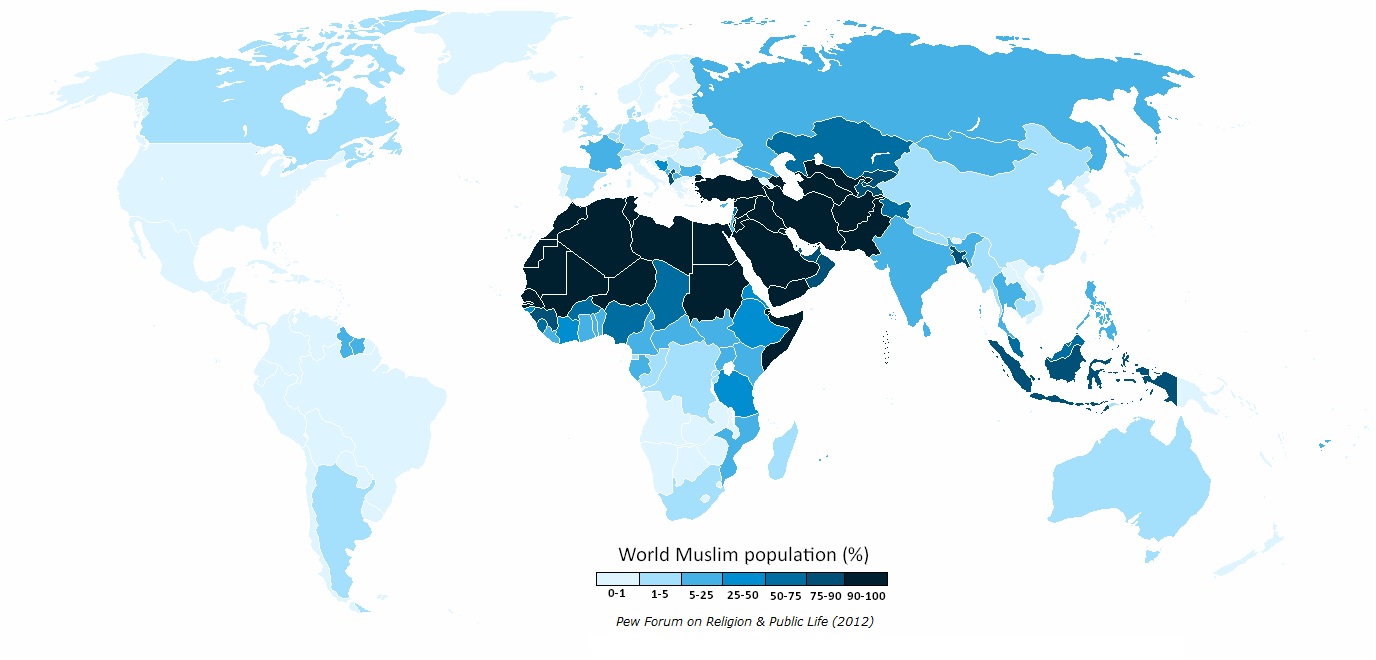
So if this is what the world looks like through the eyes of Islamocentrism, darker being more good and lighter being less good, I wonder what it looks like the other way around...

Holy Crap! It's like a negative. No wonder the Islamic world is the last bastion of the unconquered lands and seat of all that is wrong with the world... I mean, the "West" is the ever growing empire that stands for much of what is wrong with the world... oh, whatever.
But srsly, it's creepy.
I have been hung up on something for the better part of a year now: If hardcore puritans of Christianity or Islam are right (regardless of the more mainstream or liberally heretical positions) and Christianity isn't necessarily a ticket to heaven (hard-core Islam-alone), why does God hate white people, and if Islam is a ticket to hell (hard-core christianity-alone) why does God hate non-hispanic browns so much? Or maybe India a marker of God's ultimate breakdown, that the 24 million christians and 140 Million muslims go to heaven while 800 million hindus go directly to hell... somebody do the math, how does the rest of the world figure in? Um, yeah. Things start to make less sense for me when viewed on a global scale that includes numbers in the billions. No offense God, I mean, I'm sure you know what you're doing - just saying that on the ground it doesn't seem to add up too well and we are really getting confused down here.

this was the original find, but the two images above define the line of questioning even better. Highlight of this one is the tiny yellow stars that represent judaism - you'll find them in most of the major cities.
Subscribe to:
Posts (Atom)
About Me

- Sam Osborne
- I am a student @ MATC in Madison, WI. I am in the Liberal Arts Transfer Program. I plan on teaching, and on continuing my education إن شاء الله